First cohort
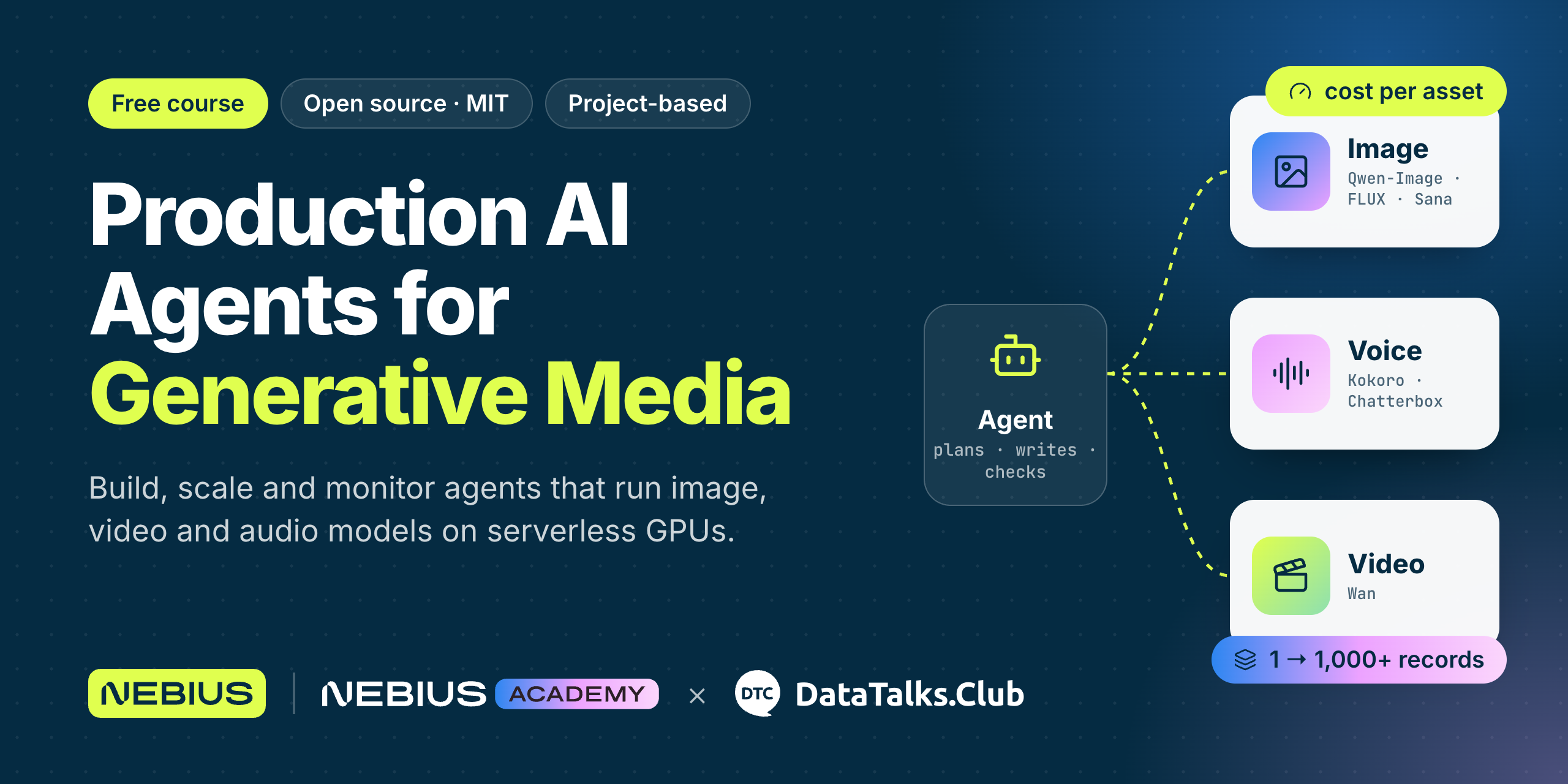
Production AI Agents for Generative Media
1143 already registered for First cohort
Registration is open.
We will send course updates by email when the edition starts.
Application only — limited seats, medium–advanced level.
Acceptance is not automatic: we review every application and approve targeted applicants. Only approved applicants join the course (projects and the full homework path). Without approval you can still audit the public materials.
Production AI Agents for Generative Media
4 weeks over 5 calendar weeks (Module 1 is two weeks) · ~8-10 h/week · free · open-source · project-based.
How do you build a production AI system when an agent can launch expensive, slow, failure-prone GPU workloads that produce large media artifacts?
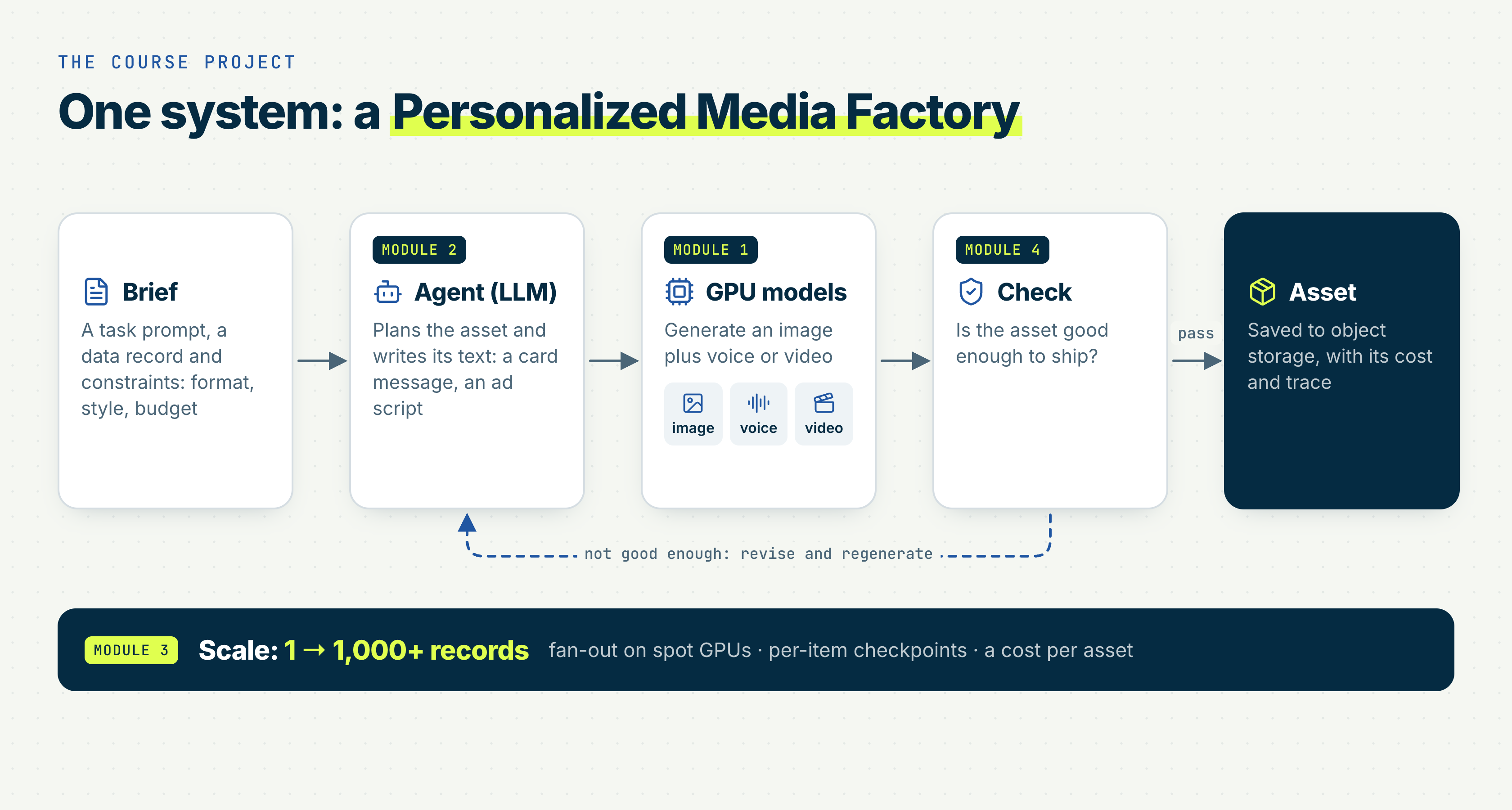
Outcome: build, deploy, evaluate, optimize and monitor a production AI system in which agents orchestrate GPU-powered image, video and audio models on Nebius Serverless AI.
Dates (2026 cohort)
- Pre-Course Live Q&A: Tue 10 Nov 2026, 17:00–18:00 Europe/Berlin
- Course starts: Mon 16 Nov 2026
- Module 1 (two weeks): Mon 16 – Sun 29 Nov 2026
- Module 2: Mon 30 Nov – Sun 6 Dec 2026
- Module 3: Mon 7 – Sun 13 Dec 2026
- Module 4: Mon 14 – Sun 20 Dec 2026
- Teaching ends: Sun 20 Dec 2026
- Capstone submission, Attempt 1: Fri 15 Jan 2027
- Peer review, Attempt 1: Fri 22 Jan 2027
- Capstone submission, Attempt 2: Fri 29 Jan 2027
- Final peer review, Attempt 2: Fri 5 Feb 2027
Course roadmap
Program
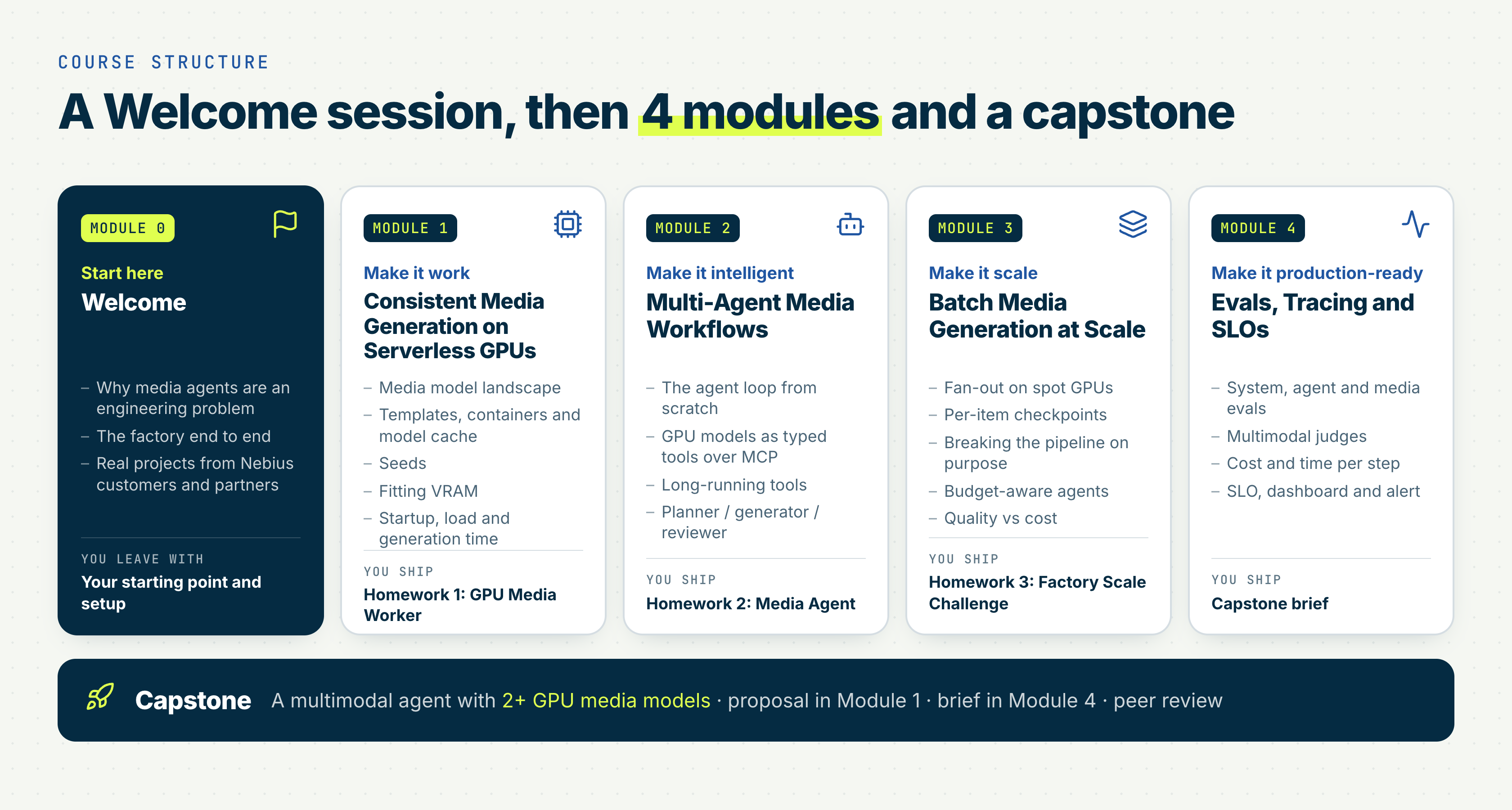
- Module 1 - Make it work. Generative media workloads: modalities and model families, first GPU generation from script to container to GPU job, containers for generative AI, GPU engineering, jobs vs endpoints.
- Module 2 - Make it intelligent. Agents that use GPUs: the agent loop, tools and structured outputs, CPU agents with GPU tools, long-running tools.
- Module 3 - Make it scale. Scaling, reliability and cost.
- Module 4 - Make it production-ready. Evaluation, observability and production.
Who this is for
- ML / MLOps / data engineers adding image, video or audio generation to real systems.
- Backend engineers turning a prototype into a service with SLOs and a cost line.
- Founders and small teams deciding when self-hosting beats per-call media APIs.
Prerequisites
Python, Docker basics, HTTP APIs, command line. No diffusion theory required. Prior LLM or MLOps course experience helps, not required.
Application only, limited seats.
What you will build
Course instructors
Alexey Grigorev (DataTalks.Club), Mikhail Rozhkov (Senior Product Manager for Serverless AI at Nebius), Marouane Khoukh (AI Engineer, DevRel at Nebius) and Aleksandr Iziumov (Staff Customer Engineer, AI & Agentic at Nebius).
Course logistics
- Course starts
- Mon 16 Nov 2026
- Live sessions and pre-course Q&A
- Pre-course Q&A: Tue 10 Nov 2026, 17:00–18:00 Europe/Berlin Open the schedule and join details
- Course content
- All course content is on GitHub: open the course repository.
- Platform page
- This page is only for logistics: homework, submissions, projects, and leaderboard.
- Questions and help
- Ask in #course-ai-mediagen on Slack .